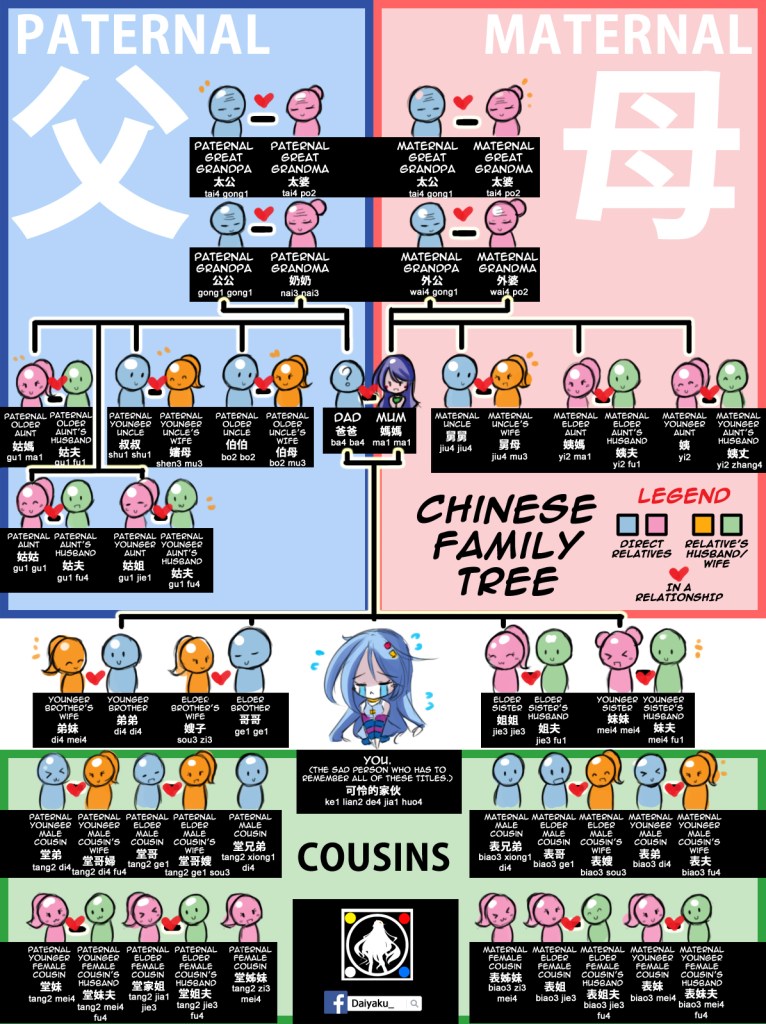
http://daiyaku.com/guess-your-relative/
Saw this interesting infographic being shared on Facebook and found the article Guess your Relative! ( http://daiyaku.com/guess-your-relative/ ) by Daiyaku. I was instantly reminded of the discussion Irene and I had a couple of days ago after visiting our respective extended families over Chinese New Year.
Now that we are officially married, we obviously have to start making changes to how we address certain people. If we lived in an entirely English speaking world, this would not be a problem as everyone is just Uncle So-and-So & Auntie Such-and-Such. However, we are Chinese living in Singapore and have somewhat traditional Chinese families who speak Mandarin. The Chinese have an extremely complicated Family Tree system as illustrated in the below video by Youtube Channel - Off the Great Wall ( https://www.youtube.com/channel/UChtzdESO4SYaxY5sNTdwl3w ) .
https://www.youtube.com/watch?v=nCFRoILS1jY
The simple part is now Irene address my mother as Mom and I address her mother as 妈 (ma). Our uncles and aunties remain the same as we've been addressing them in the same way as each other such as my 姨妈 (yi ma),姨丈 (yi zhang) and her 二姨 (er yi),小姨 (xiao yi). What changes is how our cousins, nephews and nieces would have to address us. Since we are both female, it's not possible for me to be 表姐夫 (biao jie fu) to Irene's cousins or 表姨丈 (biao yi zhang) to her nephews and nephews. Irene posted about our rather unique situation on her Facebook and some friends offered their suggestions. One of them said that I should be 表姨母 (biao yi mu) or 表姨妈 (biao yi ma). That sounds so old! I much prefer another friend's suggestion of 表姨姨 (biao yi yi). Going by this logic, Irene would become 表姑妈 (biao gu ma) or 表姑母 (biao gu mu) to my niece and nephew from my male cousin.
It is interesting to find out how people can use creative methods to manipulate the terms in Chinese culture to suit same sex relationships.
Both our families handle this differently.
Even before we were married, my mother-in-law had Baby J who is Irene's younger cousin's son addresses both Irene and myself as 表姨 (biao yi). I believe this is due to the fact that she considers both of us her daughters. I wrote about this previously in 2 parts - "Going Home for Chinese New Year ( http://jessliv.xanga.com/2009/02/18/going-home-for-chinese-new-year/ ) " and "其实,她也算是我的女儿 ( http://jessliv.xanga.com/2012/06/22/%E5%85%B6%E5%AE%9E%EF%BC%8C%E5%A5%B9%E4%B9%9F%E7%AE%97%E6%98%AF%E6%88%91%E7%9A%84%E5%A5%B3%E5%84%BF/ ) . So it is really no surprise that she decided Baby J should address both Irene and I in the same way.
My older male cousin has 2 children, Baby S and Toddler S, and they address me as 表姑 (biao gu), Irene as Auntie Irene. Perhaps it is because Toddler S was born before Zoey and we were not yet married then. Or maybe it's simply the lack of the availability of a correct term to use. My side of the family opted for the easier method - switching to English and using a generic term of "Auntie". Now that we are married, some people would say the term should change, but what would it be changed to? Should Irene be 表姑 (biao gu) as well? Or should it be 表姑妈 (biao gu ma)? Either way it's not really important to us, but I do wonder how other families in the same situation handle it and is there a better term we can use? Will have to research more into this and find out.